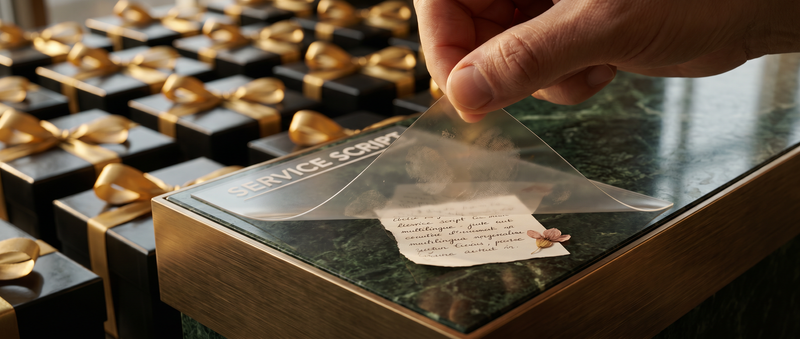
On the Seduction of What You Don't Show_
Most experience design adds more. The kind that seduces withholds — sequencing what you show, pacing thrill against chill, and letting the dramatic arc do the wanting.

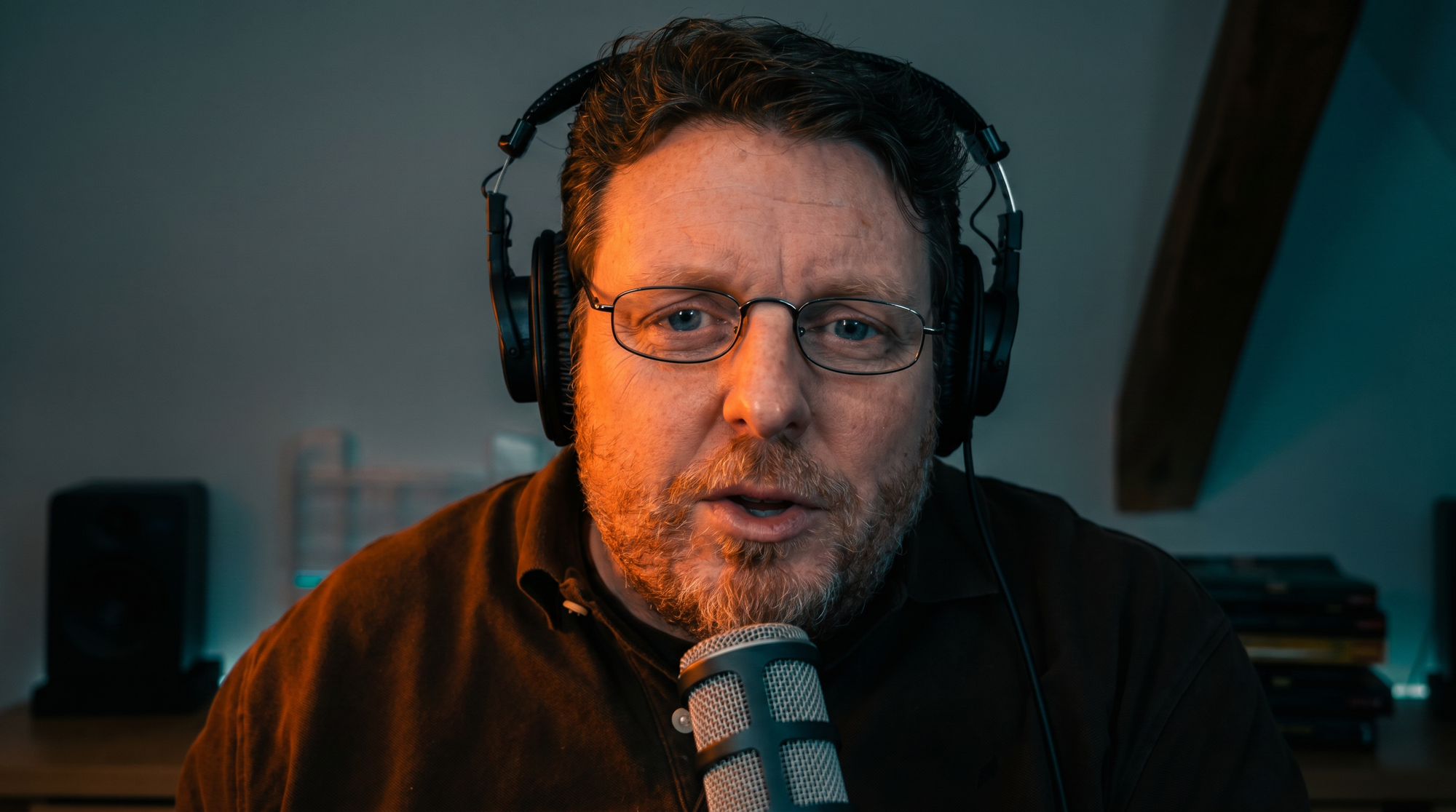
on The James Bond Experience_
With Adam Lawrence Top Selling Co-Author of "This is Service Design Doing”
To the episode →Disney's Imagineers will spend a fortune to hide a queue. An omakase counter plates twenty courses in an order you are never once asked to approve. A couture house holds its most impossible gown for the final walk, and the designer's bow for the second after that. A great room decides whether you watch the kitchen through glass or receive the plate under a silver cloche — and charges you the same either way. None of them invented a thing you could not otherwise have seen. They decided what you would see, and when. That decision — not the dish, not the gown, not the ride — is where the wanting is made.
It has a shape. And once you have seen the shape, you cannot unsee it.
The shape every great experience shares
On our show, the service designer Adam Lawrence — co-author of This Is Service Design Doing — calls it the James Bond experience.
It runs like this. A Bond film opens on an action scene that has nothing to do with the plot: a chase, a couple of small explosions, and before a word of story has been spoken you are already thinking, he's back. A boom. Then London — the briefing, the gadgets, the suit, the car. Quieter, a little dull, and you enjoy the lull anyway. Then the missions, usually three, each more exotic and more dangerous than the last; Paris, then Bangkok, then somewhere that should not be possible, the stakes climbing alongside the glamour. Then the confrontation: the loudest, most expensive, most heavily edited minutes in the film. The big boom. And then — the part everyone forgets — James becomes human again. He is tricked, or thwarted; the submarine surfaces under the rubber boat and he does not get the girl just yet. The ah.
Boom, wow, wow, wow, boom, and the human ah. You will find the same curve in a rock concert, a cruise, an album, a single episode of television — anywhere the people running the experience get to direct it. It is not a metaphor borrowed from cinema. It is the rhythm of attention itself, the shape desire takes when it is given room to build.
Here is the claim most organizations have backwards: the arc is not decoration laid over a service that works. It is the entire difference between an experience that merely functions and one that is wanted.
You almost never change what you do
The mistake is to hear "design the arc" as "spend more, add more, thrill harder." It is almost never that.
Consider the dentist — no friend to any of us. You sit in the chair, someone works in your mouth for forty-five minutes, and then: thank you, that will be six hundred. The single boom of the visit lands at the end, and it is the bill. So this dentist changed the sequence and nothing else. He cut a window from the waiting room into his laboratory, where two technicians worked gold and titanium under good light, and set a model railway in front of it — a quiet rhyme between the love of working with one's hands and the craft going on behind the glass. He moved the payment to the start, estimated a little high, and refunded the difference at the end. So you leave not with an aching jaw and an invoice, but with a smile, a selfie, and money back. The dentistry was identical. The arc was rebuilt.
Or the rainforest tram in Dominica, a cable car gliding at treetop level past birds and canopy. The first thing you actually met there was a hot car park, thick with diesel from buses idling to keep their air conditioning running. A boom, but a sour one — nothing about it whispered wonder. They did not pave the car park or ban the buses. They moved the welcome sign to the far side of it, so you were already on their land before the experience was allowed to begin — on the vista where the trees open and the pylons climb the mountain and you catch your breath.
Nothing was added in either case. No feature, no budget. Awareness was sequenced. The sour boom was hidden; the sweet one was placed where the experience could open on it.
This is the instinct no blueprint will ever hand you, because seduction has always been a matter of the withheld. The open kitchen or the closed one. The lab behind glass, or the dish carried out under silver with a flourish. Two honest choices, two different desires. The wanting is built in the editing — in the held breath before the reveal.
The dip is not dead time
There is a second half to the craft, and it is the half that nervous organizations cut first: the chill.
Thrill and chill are both good. A relentless run of booms is not intensity, it is noise — as expensive to produce as it is exhausting to receive, and in the end as forgettable as a flat line. Think of the third act of any film that is all explosion and no breath; you stop feeling any of it. The quiet is what lets the loud land. Even an insurance company knows this in its bones: no one wants to hear from it for fifteen years, and then, in the single moment that matters, wants it right there, fully present, unhurried. The art is not more. The art is the rhythm — where to leave people alone, and where to arrive like a hero.
The director, not the fixer
So the real work is not problem-solving. It is direction. To read the experience the way a film director reads a script: where do I open powerfully without over-promising, because anything I over-promise makes everything after it a quiet disappointment? Where do I step out of the frame and let the customer have the scene to themselves? Where is the strong finish — or, honestly, the finish for now — and where is the human moment that earns all the rest?
None of this rescues a service that does not actually work. A boom built on a broken promise is only a louder way to lose someone; the arc rides on top of a reliability you never break — which is the whole argument of Comfortable Is Not Alive, where desire lives in the deliberate extra beyond the met expectation, never in its place. Competence is the floor. We are talking about what gets built on it.
And what gets built on it is the only part anyone remembers, and the only part anyone repeats. The competence is assumed; the arc is what is felt, and — as we argue in the case for tellability — what gets told, breathlessly, to everyone. A great experience is edited, not assembled.
Cut accordingly.
The dentist's waiting-room window: a model railway in the foreground, two technicians working gold and titanium in the lit lab beyond. The whole point is the gaze through glass — what was made visible that used to be hidden. Caption suggestion: "What you show."
on The James Bond Experience_
With Adam Lawrence Top Selling Co-Author of "This is Service Design Doing”
To the episode →More to Read_
Adjacent threads. If this essay landed, these will too.