
The Conversation
We have all been surprised before, but we never knew what actually happens in our brains when we get this Error Signal of Surprise. Michael Rousell, is a psychologist who have been studying formative events for over 30 years, and has recently published “The Power of Surprise”. Michael explores how we process surprise, and how it affects our beliefs, emotions, and memories.
I explore with Mike how surprise could be utilized in Customer and Employee Experience, and how we can maximize the impact of those experiences.
The conversation, chapter by chapter
Every chapter with what was said in it. Open one to read it, or play the episode from that moment.
00:00:0001Intro
Read
Michael RousellWhen you're surprised, you get this error signal. What's going on?
Mahmoud AbdelrahmanPersonally for me, I always feel like there is a sudden blackout in my brain. I'm like, okay…
Michael RousellSo if you want to control the message, a surprise can do it because it bypasses things.
Michael RousellWhat it does is it generates neuroplasticity. That means your brain is plastic now. It wants to form a new belief.
Michael RousellHi, I'm Michael Rousell and I'm on OOMPH by Mahmoud.
Mahmoud AbdelrahmanThis is Season 1, O for OMG, On Magic and Surprising Customer and Employee Experience.
Mahmoud AbdelrahmanX-Raying Surprise.
00:00:5102How do our brains experience surprise?
Read
Mahmoud AbdelrahmanIf we speak about surprise, I mean, regardless if we like it or we don't, and hopefully more positive surprises than negative ones, we did get surprised as children and we continue to do so in different contexts. And surprise can be as big as something that happens nationally or in our daily life. What is surprise as a human experience? And also, from the point of view of psychology?
Michael RousellWell, as you mentioned, surprises come in all forms and they also come in all kinds of intensity. The human experience of surprise is that humans evolved because they wanted an environment that was predictable and safe. So surprise evolved as a mechanism because we want things to be predictable. When things aren't predictable, they surprise us. It's some mechanism to learn instantly, because surprises in our evolutionary past, for our ancestors, typically meant imminent danger or immense opportunity, and those that stopped to think typically perished. You missed your opportunity. Is that a tiger in the bushes?
Michael RousellAnd so thinking often interfered with survival. So we ended up with this predisposition: when surprised, learn instantly. So surprise is an alert signal. And for instance, in 2017, Wolfram Schultz out of the University of Cambridge won the Brain Prize for figuring out how dopamine operates in surprise. Now, this is fascinating for me and I hope it's fascinating for your listeners. But what happens in surprise? Surprise is essentially a neurological error signal. Something's wrong.
Michael RousellSo when you're surprised… you want things to be predictable and understandable and safe. But when you're surprised, you get this error signal. What's going on? Now, that only lasts, excuse me, that only lasts a few seconds, a few milliseconds really. And then you have to figure out: is this safe? Or is this an opportunity? Am I in danger? Because surprise, unlike happiness and anger, which come with neurological signals, surprise is the only emotion that requires an interpretation. And because it requires an interpretation, we can manipulate the response after the surprise strategically.
00:03:4103Surprise and Beliefs
Read
Michael RousellLet me give you an example of a surprise and then we'll just kind of show you how those elements play out. So you're stuck in traffic. You're not very happy. You're stuck in traffic somewhere, total gridlock. You're not even moving. And you're in the middle of the city and you look over beside you, and the car beside you suddenly lifts off the ground, hovers, zooms ahead, turns the corner and disappears. Boom. If you're like me or most people, you're going to be surprised, because you don't expect cars to hover. So this happens so quickly.
Michael RousellNow your first response is: what just happened? Am I safe? Is this an opportunity? What's going on? Is this joyous? Is this fear? And then it takes off and you look around to see: is there a motion picture set going on? What am I missing here? And you try to figure out what's going on, because in that moment, that's phasic dopamine. Phasic dopamine lasts a few milliseconds. It goes, what's just happening? It's a neurological alert sign. It's that error.
Michael RousellIt lasts a few milliseconds and it doesn't know if it's good or bad, just pay attention. And then right after that, what phasic dopamine does, that first burst, that's what Wolfram Schultz figured out: what it does is it generates neuroplasticity. And what happens is, that means your brain is plastic now. It wants to form a new belief. It's trying to figure out what's going on. And when it does that, it's trying to figure out: do I approach or avoid? Is it a danger or an opportunity? That's from our evolutionary past.
Michael RousellSo when you find out, first: is this danger? Am I attacked? Is this fun? Is it interesting? Well, eventually you figure out, oh, that was really interesting, and you remember that event. The part you don't remember is the formation of the belief. Now you have this new belief: cars can hover. Now, you didn't will it, it happened to you. There's nothing you can do. You have a new belief. You can't fight it. You've got a new belief. That's what our human experience of surprise is like.
Mahmoud AbdelrahmanPersonally for me, I always feel like there is a sudden blackout in my brain. I'm like, okay, is this the world as I know it? Does it look the same? Does it feel the same? What is happening here? And then you start to feel like you're connected again and you're probably trying to make sense out of this. From that point of view, is surprise one emotion? Is it more than one emotion? Like, what is the sequence? How do people actually experience it?
Michael RousellThat's interesting. You're going to have to put me in the camp of… even though surprise is generally thought of as an emotion, put me in the camp of: it is not an emotion. I think surprise is essentially just a neurological error signal. And what it does is, like you say, for you it was a blackout, this moment. What? Yeah, that's what happens. But it only lasts a few milliseconds. It may seem like a long time, but it's enough for you to go, what is just happening? So there's no positive, there's no negative. The surprise is just an alert signal: pay close attention.
Michael RousellAnd then immediately after that, that's the sense-making, and that happens very quickly. You try to figure out: is this an opportunity? Is this a surprise party? Should I be joyous? Is this a surprise where someone's running at me with a gun? I should be in danger. And so you quickly make that assessment and form a belief and a plan of action. It happens almost instantly. The surprise alert, that's phasic dopamine, and then after that, belief formation or plan of action. And that's because the first part, that neuroplasticity, that's the part when you said your brain goes blank. That's your brain going: figure this out. Stop whatever is going on.
00:08:1004Surprise as an Amplifier
Read
Mahmoud AbdelrahmanSo let's say, for example, a company wants to appreciate, to recognize an employee. Okay. There are a couple of ways to do this. They do it in a setting where it is somehow expected, and they do it normally with, I don't know, a certificate or a letter or something. And that looks a bit festive. Still, it can be. Or they actually craft something where this comes to them as a surprise, in a context where they didn't expect this to happen.
Mahmoud AbdelrahmanI actually have a story that can probably help us navigate this. In one of the years, I remember we needed to do promotions and stuff like that, and raises. And the way we did that is we contacted the restaurant and we had them call each employee and invite them with their families. And then they picked the time they wanted to come with their families, to just enjoy lunch, okay, and it's paid by the company. And people would think that this is a gesture and that is it, right?
Mahmoud AbdelrahmanAnd then while they are eating, the waiter comes to them. Now, the waiter is not in our context, right? He's not an employee in the company. I mean, they are in a different context. They are with family, eating, something like that. And then they give them a letter, they open the letter, they find that this is the news of their promotion and raise. And they are experiencing that within their family context and so on. Actually, for one of the cases, we had to fly them over to where their family lives, because their family were not in the same city. And then we had to arrange with a restaurant there, give them the letter there and stuff like that.
Mahmoud AbdelrahmanSo that letter or whatever could have been sent to their email, or it could have been something that's crafted around it. Psychologically, I know you did not go through the experience, they should be the ones to comment, for sure, but how do you see it from your point of view as a psychologist?
Michael RousellWhen you're giving somebody a pleasant surprise, and certainly in a controlled situation like that, it's great. It does amplify, because what happens in phasic dopamine, if it's a big enough surprise, bang. What happens with phasic dopamine, like I say, it's this total alert signal and you've got all these neurochemicals running through your brain trying to figure out what's going on. So it's this big burst. It's like fireworks going off in your head. So what happens to all these fireworks? Well, they become the emotion that follows. So instead of being a little joyous, all these neurotransmitters are going, wow, this is great, this is fireworks. And that's typically what happens in a big surprise.
00:11:0805Surprise and Memorability
Read
Mahmoud AbdelrahmanDoes that affect our memories somehow? Does surprise do anything with the memorability of events?
Michael RousellI have an interesting story that illustrates that, because the memorability part is really fascinating to me. We tend to remember the surprise, but what happens in a surprise is it bypasses thinking. We remember the surprise, but we often don't remember the belief that was driven by the surprise. Now let me give you an example. Back in the 80s, there was this famous, or not famous, a very popular… Actually, I should clear that up too. They weren't popular at the time. It was Mane 'n Tail shampoo.
Michael RousellThe mane and tail is the mane and the tail of a horse. So it's a mane and tail shampoo. But it was in the stores, on the shelves for regular shampoo, for regular people. But it was called Mane 'n Tail. And they were doing moderately well. Their whole slogan was "soft and strong". And so they tried to get it in the human shampoo aisles, which is where it was marketed. So they took out a Super Bowl commercial.
Michael RousellNow, the commercial opens with a picture of the Mane 'n Tail shampoo bottle. And then as it pans out, what you see is a young man washing his son's sudsy hair with the Mane 'n Tail shampoo, which is a common enough theme. And then as it continues to pan backwards, you see a Shetland pony. So he's turning and he's washing his son's hair, and then he turns the other way and he's scrubbing a Shetland pony. Commercial over. Okay. So that was a surprise.
Michael RousellNow what happened is, Mane 'n Tail sales skyrocketed after that commercial. And when they surveyed the people who bought the Mane 'n Tail shampoo and said, why did you buy that shampoo? they said, because it's soft and strong. And they can remember the commercial. So they said, the commercial, did the commercial influence you? And they all said, no, I buy the shampoo because it's soft and strong. They didn't think the commercial had an effect. And yet clearly it did, with sales.
Michael RousellSo you remembered the commercial, but you didn't think it drove the message, because you're smarter than a simple message, right? So that's how surprise works. Typically what you remember is the surprise itself, but not the message it drove. So if you want to control the message, a surprise can do it, because it bypasses thinking.
00:14:2806Surprise used Strategically
Read
Mahmoud AbdelrahmanIn the context of our discussion, people would want to know how they can use surprise in enhancing, strengthening and making great customer experiences and relationships with their customers, and also in the context of their employees throughout the lifecycle: from recruitment, onboarding, throughout the years, performance evaluation, and the day-to-day life, everyone going to their job, how they experience work, et cetera, until they leave a company.
Mahmoud AbdelrahmanFrom my experience, for example, in a company I worked at, because we had that element of surprise somehow embedded in the culture, it was very normal that you get to your desk in the morning and you find a message, you don't know from whom, all the time, telling you positive stuff. It's like you find, I don't know, a picture of a smiley face that says, smile, today is da da da, something like that. Or it tells you, because rain there wasn't that often, so having rain was something to really watch and experience and enjoy, so it was like, it's raining today, go and enjoy a bit of it.
Mahmoud AbdelrahmanYeah, and many of these things, even sometimes on digital platforms. But it started to become something in the DNA of the culture of the company, that people put these messages, they don't necessarily tell you. We actually used an anonymous chatbot where you can send a positive message to people on a channel, and they don't know who it is, but it's to celebrate someone. So how can we strategically use surprise within these contexts? Do you have any thoughts on that, Mike?
Michael RousellThe first couple of times, you may have been surprised with that positive message; then you're not surprised anymore. But when you walk into your office and you see a little piece of paper on your desk, and you're in that company, you're not going to be surprised. You're going to feel warm: this is a company that cares. And you recognize that somebody went out of their way to do that. And what it does is, that's not a surprise so much as an endorsement of that feeling. It's joyous, it's exciting, and it reaffirms that belief.
Michael RousellAnd every time we get a reaffirmation of our belief, we get a little boost of dopamine that says, isn't that nice? Isn't that great? Anytime we have a belief that gets affirmed, our dopamine rises a little bit. And so it's really good business practice to do it like you say, intermittently. But if you start to expect it every day, there's no surprise. And then one day it's not there, you're going to be disappointed. That's the surprise. So intermittent, that's the way to go.
Michael RousellStrategically, what you want to do is lead somebody down a path that opposes the surprise that you want to give them, so that the surprise is a juxtaposition of what they expected. You want to drive the opposite expectation, so the surprise is more emphatic. Here's an example. This is an example from real life. She's an employee in a business, and she didn't think she learned her protocols very quickly. And she worried that this would interfere with her ability to keep her job, maybe even to progress in the field, because she didn't learn her protocols quickly enough. At least that was her interpretation.
Michael RousellSo she gets called into the supervisor's office, and when she goes into the supervisor's office, her mindset is, uh-oh, I'm in trouble because I don't learn my protocols quickly. And what the supervisor said to her, and this was strategic, the supervisor said to her: "I just wanted to mention that we really like the way that you learn your protocols so thoroughly. Keep it up. You're a great leader in your field. Have a nice day." And then pick up the phone, open a file, get the hell out of my office kind of thing, because you don't want to explain a surprise. When you explain a surprise, it's like explaining a joke. So don't explain a surprise unless it goes badly; then you might have to.
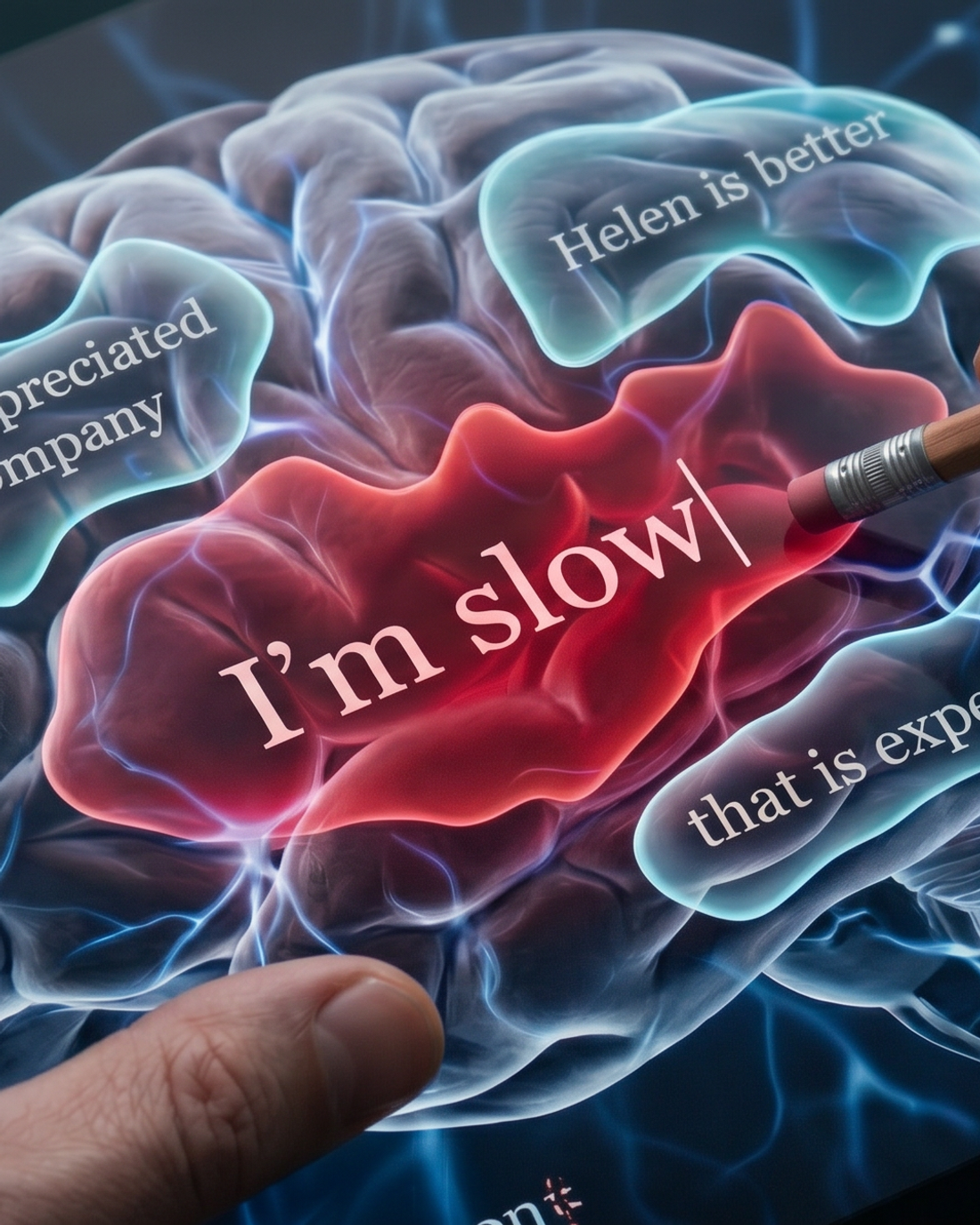
Michael RousellAnd so what happens now: she leaves, she's surprised. She expected to get in trouble and instead she's praised. And so that's the phasic surprise. And then the tonic of the new belief: I don't learn things slowly, I learn things thoroughly. So she's learning things at the same rate, but it's just named differently, named in a positive way.
Michael RousellNow, we do these kinds of things all the time with our children and our loved ones. We try to reframe. And the reframe is: you're not doing things slowly, you're really being thoughtful about that. Well, that's a good thing to say, but it doesn't tend to change the mindset. My mindset is set. If you want to change a mindset or belief, surprise can do it instantly, and you get to control the message. So there's an example of using it with your employees.
Mahmoud AbdelrahmanThank you very much, Mike, for being with me today. I really enjoyed it. And I'm sure there is a lot of value and content for everyone to process, to learn from and to put into action. Thank you.
Michael RousellThank you very much, Mahmoud.
00:20:4607In this season
Read
Tania Luna…on Alive Is the Title.
James SamperiJames Samperi, and I'm on Stunning Moments.
Adam LawrenceThis is the James Bond Experience.
Episode Shorts
Bite-sized clips from the conversation — the moments worth replaying.


Michael Rousell
Dr. Michael A. Rousell, PhD is a teacher, psychologist, and professor emeritus at Southern Oregon University. Rousell studied life-changing events for over three decades and established his expertise by writing the internationally popular book Sudden Influence: How Spontaneous Events Shape Our Lives (2007). His pioneering work draws on research from a wide variety of brain sciences that shows when, how, and why we instantly form new beliefs. Michael’s new book “The power of Surprise” examines the rich and complex nuances of the science of surprise and shows us how we can use it strategically to enrich lives.

On the Moments That Make Us
Identity — a person's, and a brand's — isn't built by accumulation. It's forged in a handful of surprising moments that rewrite what you believe about yourself. So forge them on purpose.

On Strategic Surprise, and the Persuasion No One Sees
Because surprise demands interpretation, whoever creates it supplies the meaning. The open second is the most persuadable moment a person has — and the persuasion leaves no fingerprints.
On What Surprise Rewrites
Surprise isn't an emotion — it's a neurological jolt that bypasses thinking, sears the moment into memory, and magnifies whatever you feel next. On the science of the open second, and why it cuts both ways.